I don't feel that yesterday's post was particularly coherent, a result of distractions and trying to fit it to the catchy title I came up with. This time I'll do what I usually do and write the title to fit the post. OK, cleverness failed me, but this one at least is to the point.
Western leaders are making dire pronouncements about doing something to ISIL/Islamic State, so something will happen, but two questions leap to mind. The first is "what"; the second is "how". There is already concern about mission creep, and the mission hasn't even been defined yet. The follows is my thumbnail sketch of the strategic problem posed by those assholes.
They are smack in the middle of the Middle East, straddling the increasingly irrelevant border between two failed or failing states. Their pernicious medieval nihilism, rated by at least one local resident as "worse than Genghis Khan" (who was at least religiously tolerant) is also drawing in like-minded psychopaths from around the world, like the one (apparently a Brit) who executed James Foley, constantly swelling the ranks.
I have heard the terms "counter-terrorism" and "counter-insurgency" in peoples' attempts to put a name on what needs to be done, but I have a simpler word: War. The self-proclaimed "Islamic State" is setting itself up for failure, a victim of its' own success. By making a functioning state, with its' own economy and services, you give us things that we can attack. So far it's been artillery positions, vehicles and checkpoints, but with an expansion of effort it can be a whole lot more.
In the global view, it's an ideology, really a nihilistic death cult and as an idea you can never eliminate it. Some form of Islamic violence has been around for centuries and it will continue, the issue is to minimize the damage it can do. We need to kill them in heaps and the only way to do that is when they bunch together, like they are now. We also need to limit their resources, so follow the money.
Apparently for some time now ISIL has been selling oil from seized oil fields to the rump Syria controlled by Assad. This represents the first thing I'd take away from them, even before liberating territory. You then pump that oil and sell it to finance your operations, but I can't imagine Obama'd have the stones to do that when even Bush II didn't. Concurrent with that wreck every bit of military hardware and transport you can see to weaken them militarily. Give reliable local auxiliaries (read: the Kurds, possibly Jordan) whatever they need by way of armament and logistic support. The Iraqis have Iran to backstop them, so they can sink or swim.
Osama bin Laden's grand plan was to "bleed to bankruptcy" the USA, and he did a fair job of it, but it wasn't fatal. Knocking the current set of idiots in ISIL back to a manageable local menace will require a large investment, but as opposed to Operation Iraqi Freedom there is a clear and undisputed reason to pitch in for this job. I'd be leaning on the Saudis to underwrite a lot of this and use self-interested local troops to minimize your boots on the ground.
Even in decline, the USA remains the only power capable of driving this bus, mostly due to the airpower requirements. Whoever is coordinating operations, there has to be a coherent plan, and mine already represents the 70% solution. You'll never actually kill them all but they need a serious culling and disrupting, so bring on the A-10s and Apaches, and keep the weapons and ammo flowing to Erbil.
Showing posts with label Oil. Show all posts
Showing posts with label Oil. Show all posts
Thursday, 21 August 2014


Thursday, 17 July 2014
A new Thirty-Years War?
I stole this from Jerry Pournelle's mail bag at Chaos Manor. Put aside some time and read it, I found it enlightning, albeit it asks some more questions.
By: David P. Goldman
A one-state solution to the Israeli-Palestinian conflict is upon us. It won’t arrive by Naftali Bennett’s proposal <http://www.israelnationalnews.com/News/News.aspx/181501#.U6dRlvmwJcQ> to annex the West Bank’s Area C, or through the efforts of BDS campaigners and Jewish Voice for Peace <http://jewishvoiceforpeace.org/> to alter the Jewish state. But it will happen, sooner rather than later, as the states on Israel’s borders disintegrate and other regional players annex whatever they can. As that happens, Israeli sovereignty in Judea and Samaria is becoming inevitable.
Last week’s rocket attacks from Gaza failed to inflict many casualties in Israel—but they administered a mortal wound to Palestinian self-governance. Hamas launched its deepest strikes ever into Israel after the IDF cracked down on its West Bank operations following the murder last month of three Israeli boys, arresting nearly 900 members of Hamas <https://www.middleeastmonitor.com/news/middle-east/12643-israel-has-arrested-896-palestinians-since-12-june> and other terrorist groups. Humiliated in the territories, and unable to pay its 44,000 Gaza employees <http://www.timesofisrael.com/hamas-decides-to-go-for-broke/> , Hamas acted from weakness, gambling that missile attacks would elicit a new Intifada on the West Bank. Although Fatah militias joined in the rocket attacks from Gaza, for now the Palestinian organizations are in their worst disarray in 20 years.
The settlers of Judea and Samaria have stood in the cross-hairs of Western diplomacy for two decades, during which the word “settler” has become a term of the highest international opprobrium. Yet the past decade of spiraling conflicts in the Middle East have revealed that what is settled in the region is far less significant than what is unsettled. Iran’s intervention into the Syrian civil conflict has drawn the Sunni powers into a war of attrition that already has displaced more than 10 million people, mostly Sunnis, and put many more at risk. The settled, traditional, tribal life of the Levant has been shattered. Never before in the history of the region have so many young men had so little hope, so few communal ties, and so many reasons to take up arms.
<http://cdn1.tabletmag.com/wp-content/files_mf/population1524.png>
Source: U.N. World Population Prospects <http://esa.un.org/unpd/wpp/unpp/panel_indicators.htm>
As a result, the central premise of Western diplomacy in the region has been pulled inside-out, namely that a resolution of the Palestinian refugee issue was the key to long-term stability in the Middle East. Now the whole of the surrounding region has become one big refugee crisis. Yet the seemingly spontaneous emergence of irregular armies like the Islamic State of Iraq and Syria (ISIS) now rampaging through northern Mesopotamia should be no surprise. The misnamed Arab Spring of 2011 began with an incipient food crisis in Egypt <http://www.atimes.com/atimes/Middle_East/MB02Ak01.html> and a water crisis in Syria <http://www.atimes.com/atimes/Middle_East/MC29Ak02.html> . Subsidies from the Gulf States keep Egypt on life support. In Syria and Iraq, though, displaced populations become foraging armies that loot available resources, particularly oil, and divert the proceeds into armaments that allow the irregulars to keep foraging. ISIS is selling $800 million a year of Syrian oil to Turkey, according to one estimate <http://www.al-monitor.com/pulse/business/2014/06/turkey-syria-isis-selling-smuggled-oil.html> , as well as selling electricity from captured power plants back to the Assad government. On June 11 it seized the Bajii power plant oil refinery <http://www.nytimes.com/2014/06/12/world/middleeast/the-militants-moving-in-on-syria-and-iraq.html?hp&_r=1> in northern Iraq, the country’s largest.
The region has seen nothing like it since the Mongol invasion of the 13th century. Perpetual war has turned into a snowball that accumulates people and resources as it rolls downhill and strips the ground bare of sustenance. Those who are left shiver in tents in refugee camps, and their young men go off to the war. There is nothing new about this way of waging war; it was invented in the West during the Thirty Years War by the imperial general Albrecht von Wallenstein, and it caused the death of nearly half the population of Central Europe between 1618 and 1648.
As a result of this spiraling warfare, four Arab states—Libya, Lebanon, Syria, and Iraq—have effectively ceased to exist. Lebanon, once a Christian majority country, became a Shia country during the past two decades under the increased domination of Hezbollah. Nearly 2 million Syrian Sunnis have taken refuge in Lebanon, as Israeli analyst Pinhas Inbari <http://jcpa.org/article/syrian-war-is-reshaping-the-region/> observes, and comprise almost half of Lebanon’s total population of 4 million, shifting the demographic balance to the Sunnis—while the mass Sunni exodus tilts the balance of power in Syria toward the Alawites and other religious minorities, who are largely allied with Iran. Jordan, meanwhile, has taken in a million Syrian Sunnis, making Palestinians a minority inside Jordan for the first time in a generation. A region that struggled to find sustenance for its people before 2011 has now been flooded with millions of refugees without resources or means of support. They are living for the most part on largesse from the Gulf States, and their young men are prospective cannon fodder.
The remaining states in the region—Turkey, Saudi Arabia, and Iran—will alternately support and suppress the new irregular armies as their interests require. Where does ISIS get its support, apart from oil hijacking in Syria and bank robberies in Mosul <http://www.washingtonpost.com/news/morning-mix/wp/2014/06/12/isis-just-stole-425-million-and-became-the-worlds-richest-terrorist-group/> ? There are allegations that ISIS receives support from Turkey <http://www.washingtontimes.com/news/2014/jun/17/pipes-turkeys-support-for-isis/> , the Sunni Gulf States <http://www.thedailybeast.com/articles/2014/06/14/america-s-allies-are-funding-isis.html> , and Iran <http://jcpa.org/article/isis-irans-instrument-regional-hegemony/> . Pinhas Inbari <http://jcpa.org/article/isis-irans-instrument-regional-hegemony/> claims that Shiite Iran is funding Sunni extremists “to be certain that a strong Iraqi state does not emerge again along its western border.” There are equally credible reports that each of these powers wants to stop ISIS. Saudi Arabia fears <http://www.al-monitor.com/pulse/originals/2014/05/isis-saudi-arabia-qaeda-terrorism-syria.html> that Sunni extremists might overthrow the monarchy. Turkey fears that the depredations of ISIS on its border will trigger the formation of an independent Kurdish state, which it has opposed vehemently for decades. Iran views ISIS as a Sunni competitor for influence in the region.
To some extent, I believe, all these reports are true. The mess in the Middle East brings to mind the machinations around Swedish intervention in the Thirty Years War between 1627 and 1635, when France’s Cardinal Richelieu paid Sweden’s King Gustavus Adolphus to intervene on the Protestant side in order to weaken France’s Catholic rival Austria. At different times, Protestant Saxony and Catholic Bavaria allied with France, Austria, and each other, respectively. France and Sweden began as allies, briefly became enemies, and then were allies again. Looming over this snake-pit of religious, dynastic, and national rivalries was the figure of Albrecht von Wallenstein, the Austrian generalissimo who twice saved the Empire from defeat at the hands of the Protestants. Wallenstein, commanding a polyglot mercenary army with no national or religious loyalty, played both sides, and Austria had him murdered in 1634.
There is more than coincidence to the parallels between the Middle East today and 17th-century Europe. Iran’s intervention into Syria’s civil conflict inaugurated a new kind of war in the region, the sort that Richelieu practiced in the 1620s. Iran’s war objectives are not national or territorial in the usual sense; rather, the objective is the war itself, that is, the uprooting and destruction of potentially hostile populations. With a third of Syria’s population displaced and several million expelled, the Assad regime has sought to change Syria’s demographics to make the country more congenial to Shiite rule. That in turn elicits a new kind of existential desperation from the Saudis, who are fighting for not only the survival of their sclerotic and corrupt monarchy, but also for the continuation of Sunni life around them. Today Iraq’s Sunnis, including elements of Saddam Hussein’s mainly Sunni army and the 100,000 strong “Sons of Iraq” force hired by then-U.S. commander Gen. David Petraeus during the 2007-2008 surge, are making common cause with ISIS. Tomorrow they might be shooting at each other. The expectation that the waves of sectarian and tribal violence that have caused national borders to crumble across the Middle East will die down in 30 years may be both incredibly grim and wildly optimistic.
***
In the background of the region’s disrupted demographics, a great demographic change overshadows the actions of all the contenders. That is decline of Muslim fertility, and the unexpected rise in Jewish fertility. The fall in Muslim birth rate is most extreme in Iran and Turkey, with different but related consequences. When Ayatollah Khomeini took power in 1979, the average Iranian woman had seven children; today the total fertility rate has fallen to just 1.6 children, the sharpest drop in demographic history. Iran still has a young population, but it has no children to succeed them. By mid-century Iran will have a higher proportion of elderly dependents than Europe, an impossible and unprecedented burden for a poor country. Iran’s sudden aging will be followed by Turkey, Algeria, and Tunisia.
<http://cdn1.tabletmag.com/wp-content/files_mf/popover65.png>
Source: U.N. World Population Prospects <http://esa.un.org/unpd/wpp/unpp/panel_indicators.htm>
Iran’s disappearing fertility is in a sense the Shah’s revenge. Iran is the most literate Muslim country, thanks in large part to an ambitious literacy campaign introduced by the Shah in the early 1970s. As I showed in my book How Civilizations Die (and Why Islam Is Dying, Too), literacy is the best predictor of fertility in the Muslim world: Muslim women who attend high school and university marry late or not at all and have fewer children. This has grave strategic implications, as Iran’s leaders unabashedly discuss.
Between 2005 and 2020, Iran’s population aged 15 to 24, that is, its pool of potential army recruits, will have fallen by nearly half. To put this in perspective, Pakistan’s military-age population will have risen by about half. In 2000, Iran had half the military-age men of its eastern Sunni neighbor; by 2020 it will have one-fourth as many. Iran’s bulge generation of youth born in the 1980s is likely to be its last, and its window for asserting Shiite power in the region will close within a decade.
The Obama Administration wants to contain Iranian aggression by accommodating Iran’s ambitions to become a regional power. As the president told <http://www.bloombergview.com/articles/2014-03-02/obama-to-israel-time-is-running-out> Bloomberg’s Jeffrey Goldberg in March, “What I’ll say is that if you look at Iranian behavior, they are strategic, and they’re not impulsive. They have a worldview, and they see their interests, and they respond to costs and benefits. And that isn’t to say that they aren’t a theocracy that embraces all kinds of ideas that I find abhorrent, but they’re not North Korea. They are a large, powerful country that sees itself as an important player on the world stage, and I do not think has a suicide wish, and can respond to incentives.” Any deal with Iran is therefore a good deal from Obama’s point of view. But that is precisely wrong: Iran does not have a suicide wish, but it knows that it is dying, and has nothing to lose by rolling the dice today.


Tuesday, 6 May 2014
Legion Etranger a louer?
The world (e.g. mainstream media) has finally figured out that Boko Haram is an unpleasant organisation. Think of them as Al-Queda of the sub-Sahara and you get the idea; they've been running amok in Nigeria for a few years now, so everyone posting "Bring Back our Girls" to Facebook are both behind the times and useless to the actual situation.
As is my wont, I don't simply enumerate problems, I propose practical solutions. Knee-jerk response is for Nigeria to get its' head out of its' ass and send the entire army on a search and destroy mission to wipe BH from the face of the earth. Rank corruption and incompetence make that impractical or it would have happened already, so something else then.
The French have shown the way in Africa (Mali and most recently Central African Republic), and as un-PC as it is, it's 1st-World armies to solve 3rd-World problems. In my world, if it's locals causing the problem, opposed locals should be able to solve it with minimal assistance. People on Facebook seem to think this is America's responsibility, a default option with surprisingly racist undertones if you think about it. Normal media racism is directed solely against whites (damn all that privilege!) but when you assume that Western armies are the only ones capable of dealing with African problems, that's a flat-out colonial attitude. What's worse is that it's demonstrably true (Rwanda's RPF in 1994 an exception).
The key to an effective military is professionalism, something that the anarchy and crony despotism of most African states doesn't produce a lot of. I'm reminded of a report I saw from the mess in South Sudan earlier this year. In an army column sent to rout some rebels there was one young Sandhurst-trained Lt who appeared to know his business, but the rest of them were hopeless. Individual platoon commanders led by crony generals don't get much done, however.
So Nigeria needs western troops to do the job right, but the West is broke, tired and overstretched, not likely to jump into things. The necessary ingredients for a successful intervention are:
I think this was the origin of "Hammer's Slammers" but using our trained volunteer troops as mercenaries is as close to an optimal solution to this problem as we are likely to see. There is no shortage of type-A adrenalin junkies in Western armies to volunteer for a unit like this and putting an English-speaking international Brigade Group together is feasible, however unlikely it may be.
Failing that, maybe it's time to bring "Mad" Mike Hoare out of retirement. He's a bit past it of course, but he and the other Congo Mercenaries showed how it could be done. Nigeria is unlikely to hire a bunch of primarily white mercs for this job, but I wonder how close we are to the point where the government and the populace will countenance anything that will get the job done? As things stand, the government is the problem so I don't hold out much hope for improvement in the near term.
As is my wont, I don't simply enumerate problems, I propose practical solutions. Knee-jerk response is for Nigeria to get its' head out of its' ass and send the entire army on a search and destroy mission to wipe BH from the face of the earth. Rank corruption and incompetence make that impractical or it would have happened already, so something else then.
The French have shown the way in Africa (Mali and most recently Central African Republic), and as un-PC as it is, it's 1st-World armies to solve 3rd-World problems. In my world, if it's locals causing the problem, opposed locals should be able to solve it with minimal assistance. People on Facebook seem to think this is America's responsibility, a default option with surprisingly racist undertones if you think about it. Normal media racism is directed solely against whites (damn all that privilege!) but when you assume that Western armies are the only ones capable of dealing with African problems, that's a flat-out colonial attitude. What's worse is that it's demonstrably true (Rwanda's RPF in 1994 an exception).
The key to an effective military is professionalism, something that the anarchy and crony despotism of most African states doesn't produce a lot of. I'm reminded of a report I saw from the mess in South Sudan earlier this year. In an army column sent to rout some rebels there was one young Sandhurst-trained Lt who appeared to know his business, but the rest of them were hopeless. Individual platoon commanders led by crony generals don't get much done, however.
So Nigeria needs western troops to do the job right, but the West is broke, tired and overstretched, not likely to jump into things. The necessary ingredients for a successful intervention are:
- Competent, motivated troops;
- Political will, and;
- Money.
I think this was the origin of "Hammer's Slammers" but using our trained volunteer troops as mercenaries is as close to an optimal solution to this problem as we are likely to see. There is no shortage of type-A adrenalin junkies in Western armies to volunteer for a unit like this and putting an English-speaking international Brigade Group together is feasible, however unlikely it may be.
Failing that, maybe it's time to bring "Mad" Mike Hoare out of retirement. He's a bit past it of course, but he and the other Congo Mercenaries showed how it could be done. Nigeria is unlikely to hire a bunch of primarily white mercs for this job, but I wonder how close we are to the point where the government and the populace will countenance anything that will get the job done? As things stand, the government is the problem so I don't hold out much hope for improvement in the near term.
Update: the Yanks are sending people to help out at the request of the Nigerian government, so we'll see if they provide the nucleus of a force to wipe Boko Haram off the map. I'm willing to be surprised.
Friday, 24 August 2012
Back to the 80s, a new Cold War for the 21st Century?
Hey China, welcome to the 1980s in missile tech:
News first emerged of the planned ‘super missile’ from defence industry bible Jane’s Defence Weekly last week, according to South China Morning Post.
It apparently claimed that a Dongfeng-41 (DF-41) intercontinental ballistic missile (ICBM), had been fired in testing last month by the PLA’s Second Artillery Corps.
This third-generation missile, US military sources told Jane’s, contain multiple independently targetable re-entry vehicles (MIRVs) – effectively multiple warheads – meaning they would be almost impossible for current US defences to take down.
This sounds a whole lot like a Minuteman III or some such from the height of the Cold War, and by itself is nothing to get exercised about, despite flying in the face of current Arms Control agreements. What this sort of rumour/announcement really signifies (if you somehow missed the rest of the signs) is that China has plans to expand.
The Americans have of late finally noticed this, and will hopefully allow the Arabs etc. to kill each other in the Middle East and concentrate on something which actually threatens their position in the world (almost as much as the current system of government). Mitt Romney, presently the de facto Republican Presidential nominee, has just pushed out a plan for North American energy independence which is a step in the right direction, but he has to a) be elected and b) actually follow through on the plan for it to make a difference.
I really don't know what China intends with this; that sort of a missile is a threat to both the US and Russia, overkill against India (or less likely, Pakistan), but doesn't materially change the deterrent of either of the major powers. Likely it's for internal political consumption and it's possible they're not even seriously pursuing it, at least not as an ABM-busting strategic weapon.
In any event, the world is re-aligning, and China is doing itself no favours in the international community by backing places like Iran and Syria. The truth of the matter in the South China Sea is that without the US Navy none of the smaller regional actors have a chance against China, and everyone knows it. In order therefore to defend its' broader national interest (e.g. global trade) the USA needs to get its' house in order by boosting it's economy in real terms.
A rational energy and regulatory program will help that a lot, another four years of Obama binding the country up in red (green?) tape and having an indefinable foreign policy will not help at all. Romney et al might be an improvement, but the system is now so ponderous and corrupt that I have my doubts that anything short of armed rebellion will make much of a difference. Note that none of this is an endorsement of such an uprising (Canada can't absorb that many refugees if nothing else), but I will for what it's worth say that I see Romney as the best of a bad lot.
The next five years or so are critical to the trajectory of the USA and of China, and whatever happens it'll affect the whole world. The big question seems to be: new Cold War, or a Hot one?
News first emerged of the planned ‘super missile’ from defence industry bible Jane’s Defence Weekly last week, according to South China Morning Post.
It apparently claimed that a Dongfeng-41 (DF-41) intercontinental ballistic missile (ICBM), had been fired in testing last month by the PLA’s Second Artillery Corps.
This third-generation missile, US military sources told Jane’s, contain multiple independently targetable re-entry vehicles (MIRVs) – effectively multiple warheads – meaning they would be almost impossible for current US defences to take down.
This sounds a whole lot like a Minuteman III or some such from the height of the Cold War, and by itself is nothing to get exercised about, despite flying in the face of current Arms Control agreements. What this sort of rumour/announcement really signifies (if you somehow missed the rest of the signs) is that China has plans to expand.
The Americans have of late finally noticed this, and will hopefully allow the Arabs etc. to kill each other in the Middle East and concentrate on something which actually threatens their position in the world (almost as much as the current system of government). Mitt Romney, presently the de facto Republican Presidential nominee, has just pushed out a plan for North American energy independence which is a step in the right direction, but he has to a) be elected and b) actually follow through on the plan for it to make a difference.
I really don't know what China intends with this; that sort of a missile is a threat to both the US and Russia, overkill against India (or less likely, Pakistan), but doesn't materially change the deterrent of either of the major powers. Likely it's for internal political consumption and it's possible they're not even seriously pursuing it, at least not as an ABM-busting strategic weapon.
In any event, the world is re-aligning, and China is doing itself no favours in the international community by backing places like Iran and Syria. The truth of the matter in the South China Sea is that without the US Navy none of the smaller regional actors have a chance against China, and everyone knows it. In order therefore to defend its' broader national interest (e.g. global trade) the USA needs to get its' house in order by boosting it's economy in real terms.
A rational energy and regulatory program will help that a lot, another four years of Obama binding the country up in red (green?) tape and having an indefinable foreign policy will not help at all. Romney et al might be an improvement, but the system is now so ponderous and corrupt that I have my doubts that anything short of armed rebellion will make much of a difference. Note that none of this is an endorsement of such an uprising (Canada can't absorb that many refugees if nothing else), but I will for what it's worth say that I see Romney as the best of a bad lot.
The next five years or so are critical to the trajectory of the USA and of China, and whatever happens it'll affect the whole world. The big question seems to be: new Cold War, or a Hot one?
Saturday, 9 June 2012
Risk Management and Civilization
The title link is to the oil spill from a pipeline in Alberta in the last week. There is the usual bashing of "Harper" and "Big Oil" but as it came the same week as the following I saw some blog synchronicity:
The leftist Utopian mindset is that we should get something for nothing, whether it be services (rioting "students" in Montreal this spring) or "Green" energy. Shit ain't like that, as Newton encapsulated many moons ago. There are reactions to actions, and while these can and should be be mitigated when possible, changing anything from one state to another will have a range of effects, not all of which we want.
That is where the mitigation strategies come in because radical environmentalist cant aside, the era of rampant pollution is past. Air and water are cleaner (in the developed world) than they were 40 years ago, and it's because of improved practices and technology. This brings us to Diminishing Returns and Risk Management.
It's difficult to ascribe priority to one or the other as I can make an argument either way, but for purposes of this post I'll give Risk Management planning priority. I'll also give my own interpretation of RM which is as follows: with a particular end-state in mind (affordable energy, for example) you decide what will do more damage, the various ways of producing it or the effects of not having it.
I'm sure that's close enough for unpaid work (e.g. here) to work with, and the position of the Japanese PM re: reactors is pretty much a textbook example of risk management. With all reasonable (more on that in a bit) precautions taken, the damage to society would be far greater if the power generation is foregone than the risk presented by the possibility of accident in the production of it.
It's NOT about wringing ones' hands about the worst-case-scenario and assuming that (however unlikely it is) will be what happens. In this case, something pretty close to the worst case happened at Fukushima, and as much of a mess as it is NOBODY HAS DIED because of the radiation released from it. This is after an old (and sub-optimally designed) fission reactor was completely overwhelmed by a massive natural disaster which itself killed over 15,000 people leveled a number of small cities and actually changed the elevation of those seaside areas.
There aren't a lot of ways in which that could get worse in terms of what happened in the end result at the reactor complex itself. The Wikipedia link seems (at tme of writing) well balanced, and even the worst-case reputable estimate for lifetime cancer increase amoungst those exposed (100 cases) pales in comparison to the devastation wrought by any good-sized quake in Japan. Fukushima was rated at the same level of "devastation" as Chernobyl which is questionable at the very least from the point of view of fatalities.
Chernobyl was indeed the worst case (see link above) and I notice that the world has not ended, save for the <300 people who died as a direct result of it. Risk Management in the USSR was a very blunt instrument, leading to bad designs like the RMBK reactors. Three Mile Island marked the death knell of the American nuclear power program and NOBODY even got measurably sick from it.
The word for the reaction to all of these events is "panic". I'm not a fan of panic, but there are times when some healthy caution is in order when things go wrong. It breaks, you fix it, you carry on. You do it with your car (or bike if you're a real Green hardcase), you don't say "OMG, it broke and it could fail catastrophically, cars/bikes must be banned!"
Back to the oil spill. These have happened thousands of times in the last 100+ years and again, the world has yet to end as we know it or otherwise. I am not a fan of industrial accidents, but a certain failure rate is the price of doing anything that accomplishes anything. We take reasonable precautions, the state of "reasonable" being a moving target depending on time and perspective.
Enter Diminishing Returns. Of course if we have no rules we see all sorts of short-term gain behaviour which is why unbridled capitalism is a bad idea. That said, the "worker's paradise" of the USSR and satellite Commie states made a MUCH bigger mess of the environment than the Evil Capitalist West. At a certain point in trying to improve something you will hit that point when a further 1% improvement in x will require increasingly more effort past the diminishing returns point than what led to it.
It happens with schoolwork, it happens at work and it gets to the point where further improvement is either impossible or would be uneconomical in effort or expense. Zero-defect is what we seem to expect these days, and that 's not the way things work. The key to keeping the wheels on is to not getting bogged down striving for perfection, but to keep moving forward as best we can.
Cheap clean energy is the key to the future, and the dividing line on the global warming/climate change seems to involve the definition of what is cheap and what exactly is clean. Right now natural gas seems to split the difference with only radical anti-CO2 wingnuts having a problem with it. The supposed "environmentally friendly" sources of wind and solar are anything but, and hydrocarbon based energy will be with us for the foreseeable future. As we will also be around for the (by definition) foreseeable future, we have to do the best we can to not "shit where we eat".
The best we can do will never completely eliminate human error or materials failure. We can however keep improving things as long as we keep things in perspective and keep the people who are producing what we need honest. People aren't good at thinking rationally about stuff so we'll make a mess of it, but in the meantime we'll keep the lights on and our food coming to us by making as few errors as possible while not making it impossible for people to do the things we need them to. Mistakes will be made, but clean them up, learn the appropriate lessons and keep moving forward.
Monday, 17 October 2011
Keystone Quixote
With the Occupy *.* protests going in fits and starts all over North America, I will come back to what I threatened to talk about a little while ago. Specifically that's the Keystone XL pipeline project and more generally, geopolitical energy policy.
Oil is messy stuff; you'll get no arguments from me on the basics. There have been and will be leaks in pipelines all over the world (less when people aren't actively breaching them) so the environmental concerns are not to be dismissed. I do however have some sympathy for those who complain that the facts are being distorted by "celebrity protesters". To try to put this in perspective to facilitate a less fraught risk assessment, let's zoom way out and start from there:
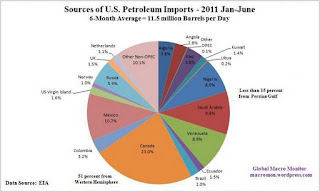
We (and this includes the USA) need petroleum in many forms and we need lots of it. Even if/when we get to the point where we can stop burning it (I hope to live that long at least) we will still need it to make things, and it will need to be transported. Moving as much of the transportation and generation grid (big trucks, power plants etc.) over to natural gas will help to reduce the amount of oil which will be sloshing around the continent, and we have lots of NG so supply will be "merely" logistics. LNG likes to explode if you're careless with it, but it's not much of a spill risk unless it lands on you (really REALLY cold). Although not as completely pollution free as Hydrogen, it's far easier to work with. There remains the thermodynamically inescapable fact that petroleum products (gasoline, diesel, kerosene, etc.) have a much higher energy density than you can get from propane, methane et al, and there's the infrastructure cost of providing places for these vehicles to fuel, so oil is not going away just yet.
So the oil needs to come from somewhere, and the Oil Sands are close and friendly to the US. This is as opposed to (for example) Venezuela which is arguably closer, depending on the refinery, but not (presently) friendly and we're talking tankers. While I'm on the subject of tankers, they don't seem to be the menace you'd assume them to be, but they get a lot of press due to the impressive swath of oily mess they cause. Leaky pipelines are typically unspectacular, although your groundwater may feel differently. This brings us back to the NIMBY problem which brought this to you today, and the current US administration's hostility to "Drill, baby, drill!"
Countries have no permanent Friends and no permanent Enemies, only permanent Interests. I really don't want to think too much about what happens if Canada is no longer friends with the US (although the words Manifest Destiny pop into my head), but if their money has to go somewhere, at least they can be certain we're not financing terrorist groups with it. They need Oil, and we have oil, so it should work out. However if it doesn't, China ALSO needs oil; if the Americans get too wrapped around the axle about how "dirty" the oil is, I'll happily sell to whoever wants to buy.
Economics are a permanent Interest for all concerned. Well, not all; those protesters (especially the "celebrity" ones) have a very narrow focus and keeping the economy moving is not part of it. This is the crux of the issue, balance and Risk Assessment. In the "pro" column is security of supply. In the "con" there is cost and environmental risk. "Con" is here as objective as possible and takes ideology out of it as much as possible; in this day and age ignoring the environmental potential of something is not an option, but the number of variables that encompasses is a matter of ideology.
How this balances out depends (as always) on where you put the weight. Since I have no skin in the game I come down on the side of "build it", assuming that it is done properly. This is for simple geopolitical and economic reasons, both serviced by the "pro", and my caveats cover (to my satisfaction) the "con". I realize that you will feel differently if it's going through your fields or aquifer and I have no pat response to that, but Darryl Hanna and the rest of them still annoy me, mostly because it's another bandwagon for them.
Here's some more of my ideology at work: all of this is happening because nuclear energy has not been supported and developed. Tripling the output of conventional fission plants could provide all of the energy the US currently gets from coal, accomplishing Obama's goal of driving coal plants out of business and cutting way back on pollution. The current fetish of blaming CO2 for all that's wrong in the world would be satisfied by that, and if they got some thorium action going they could take fossil fuels out of the generation sector entirely while ensuring domestic control of reliable energy. There'd be a boom in construction as well.
Of course this does nothing about the need to move crude to refineries, but abundant and cheap electricity could (with improved battery tech) make electric vehicles more practical, reducing the need for petrol. All of this and no need for ugly noisy unreliable wind turbines cluttering the landscape; try that, H. Boone Pickens .
Oil is messy stuff; you'll get no arguments from me on the basics. There have been and will be leaks in pipelines all over the world (less when people aren't actively breaching them) so the environmental concerns are not to be dismissed. I do however have some sympathy for those who complain that the facts are being distorted by "celebrity protesters". To try to put this in perspective to facilitate a less fraught risk assessment, let's zoom way out and start from there:

We (and this includes the USA) need petroleum in many forms and we need lots of it. Even if/when we get to the point where we can stop burning it (I hope to live that long at least) we will still need it to make things, and it will need to be transported. Moving as much of the transportation and generation grid (big trucks, power plants etc.) over to natural gas will help to reduce the amount of oil which will be sloshing around the continent, and we have lots of NG so supply will be "merely" logistics. LNG likes to explode if you're careless with it, but it's not much of a spill risk unless it lands on you (really REALLY cold). Although not as completely pollution free as Hydrogen, it's far easier to work with. There remains the thermodynamically inescapable fact that petroleum products (gasoline, diesel, kerosene, etc.) have a much higher energy density than you can get from propane, methane et al, and there's the infrastructure cost of providing places for these vehicles to fuel, so oil is not going away just yet.
So the oil needs to come from somewhere, and the Oil Sands are close and friendly to the US. This is as opposed to (for example) Venezuela which is arguably closer, depending on the refinery, but not (presently) friendly and we're talking tankers. While I'm on the subject of tankers, they don't seem to be the menace you'd assume them to be, but they get a lot of press due to the impressive swath of oily mess they cause. Leaky pipelines are typically unspectacular, although your groundwater may feel differently. This brings us back to the NIMBY problem which brought this to you today, and the current US administration's hostility to "Drill, baby, drill!"
Countries have no permanent Friends and no permanent Enemies, only permanent Interests. I really don't want to think too much about what happens if Canada is no longer friends with the US (although the words Manifest Destiny pop into my head), but if their money has to go somewhere, at least they can be certain we're not financing terrorist groups with it. They need Oil, and we have oil, so it should work out. However if it doesn't, China ALSO needs oil; if the Americans get too wrapped around the axle about how "dirty" the oil is, I'll happily sell to whoever wants to buy.
Economics are a permanent Interest for all concerned. Well, not all; those protesters (especially the "celebrity" ones) have a very narrow focus and keeping the economy moving is not part of it. This is the crux of the issue, balance and Risk Assessment. In the "pro" column is security of supply. In the "con" there is cost and environmental risk. "Con" is here as objective as possible and takes ideology out of it as much as possible; in this day and age ignoring the environmental potential of something is not an option, but the number of variables that encompasses is a matter of ideology.
How this balances out depends (as always) on where you put the weight. Since I have no skin in the game I come down on the side of "build it", assuming that it is done properly. This is for simple geopolitical and economic reasons, both serviced by the "pro", and my caveats cover (to my satisfaction) the "con". I realize that you will feel differently if it's going through your fields or aquifer and I have no pat response to that, but Darryl Hanna and the rest of them still annoy me, mostly because it's another bandwagon for them.
Here's some more of my ideology at work: all of this is happening because nuclear energy has not been supported and developed. Tripling the output of conventional fission plants could provide all of the energy the US currently gets from coal, accomplishing Obama's goal of driving coal plants out of business and cutting way back on pollution. The current fetish of blaming CO2 for all that's wrong in the world would be satisfied by that, and if they got some thorium action going they could take fossil fuels out of the generation sector entirely while ensuring domestic control of reliable energy. There'd be a boom in construction as well.

Of course this does nothing about the need to move crude to refineries, but abundant and cheap electricity could (with improved battery tech) make electric vehicles more practical, reducing the need for petrol. All of this and no need for ugly noisy unreliable wind turbines cluttering the landscape; try that, H. Boone Pickens .
Friday, 27 May 2011
More power to us
Petrol prices being unreasonably high again, it seems a good time to get into a ramble about how we will continue to support an advanced technological society. If it was easy everyone would be doing it, but it seems that salvaging a decent standard of living for our kids and grand kids will take some work and imagination.
For the moment, oil rules the energy world. It is abundant (Peak Oil pundits notwithstanding), and the most easily transported source of dense energy, but the sky is not blue for consumers and the economy. Yes we have lots of it, but what we're running out of is cheap, easy to get oil. If the Abiogenic Oil hypothesis is correct it may be renewable, but not on any timescale that will help us so that's largely irrelevant even it happens.
The Alberta Oil Sands were "mothballed" for years because the price of oil was too low for them to be commercially viable. The fact that they're being worked in a big way today is proof that the days of cheap oil are over. That said the current high prices (c.$1.25/L) at the pumps are mostly speculation, and such high prices at the sharp end are not justified on the supply side.
The cost of transport going up over 20% in the last year has placed great inflationary pressure on individuals and businesses which in turn sets off a vicious circle of higher prices for everything and less discretionary spending. It also increases costs for government operations (fire, police, military, etc.) and lessens the amount of sales tax they (fed and provincial/state) pull in. At the municipal level it means higher property taxes, further eroding spending power.
I hope those examples suffice to make my point, which is: Cheap Energy is the Key to Prosperity. Prosperity is fundamental to the kinder gentler welfare states we try to pull off, so wherever you fall on the political spectrum/Venn diagram you should be in favour of prosperity. The news to a lot of people seems to be that the money for policies has to come from somewhere (that would be you on the Left), and squeezing the taxpayers is a process of rapidly diminishing returns. You do indeed run out of other peoples' money...
The good news is that as long as we can keep the clueless Luddite environmentalists at bay we have clean sustainable options. I will go on record here as saying that wind turbines are NOT included in this, as they are worse than useless for large-scale power generation, kill birds and bats in huge swathes, blight the landscape and very possibly make people ill with the vibrations they cause. Not in MY backyard; I'd rather have a nice quiet thorium power plant.
Fear ruins so much of what we might accomplish. The radiation bogeyman easily has people shitting their pants even when there is no massive disaster to give them something to be concerned about. This is obviously an allusion to the Daiichi reactor incidents. The earthquake which precipitated the tsunami which overwhelmed the redundant safety features on those 40+ year-old designs was massive, and there are limits to engineering.
Lessons had been learned since those plants were designed and even more can be done; after all that natural disaster killed over 18,000 people and destroyed billions of any unit of currency in property. The radiation from the leaks hasn't killed anyone to date and even if (IF!) a few die of cancer a few years early that's still a formidable safety record even in failure considering the forces and substances involved.
More (smaller, better designed) fission plants, check. The Grail of nuclear energy is fusion power, but that is perennially "30 years away" so I'll disregard it. I've mentioned it before, but our best option to replace everything we don't like (read: coal) is some form of Thorium reactor. We have lots of it, the technology needs tweaking but is within the state of the art and it's as safe as anything involving toxic metals at high temperatures can be. That sounds flippant, but they can't explode or melt down, so any accident would be an industrial one and do a lot less damage than say a refinery explosion.
Sold; when do we get them? What else? Space-based solar would be great but I don't see it happening even in my lifetime. Ground solar is not yet efficient enough to offset it's cost and the fact that the sun isn't always shining on you, but improvement continues. If battery tech can advance with them we'll have worthwhile home systems, at least for those who can afford it.
This comes back to the "cheap" part of the energy question. Every dollar that you need to spend on energy in any form is money you don't have to keep businesses going, keeping people employed, keeping taxes going to fix your roads, etc., etc. Spending $50K to wean yourself off the fickle (where I live anyway) grid with solar power will take a long time to pay off. Think of the economics of the current generation of hybrid and electric cars; less at the pump, sure, but how much gas could you buy with the extra you spent for the low-rate production semi-experimental vehicle you're driving?
Again with the "no free lunches". I don't see a lot of political leadership which either thinks things all the way through or encourages the public to do so, I guess that's why I keep doing this. Start working on Thorium power now, not in 20 years when we'll have needed it for 10. Go ahead political leaders, surprise me and actually do something with legitimate foresight.
For the moment, oil rules the energy world. It is abundant (Peak Oil pundits notwithstanding), and the most easily transported source of dense energy, but the sky is not blue for consumers and the economy. Yes we have lots of it, but what we're running out of is cheap, easy to get oil. If the Abiogenic Oil hypothesis is correct it may be renewable, but not on any timescale that will help us so that's largely irrelevant even it happens.
The Alberta Oil Sands were "mothballed" for years because the price of oil was too low for them to be commercially viable. The fact that they're being worked in a big way today is proof that the days of cheap oil are over. That said the current high prices (c.$1.25/L) at the pumps are mostly speculation, and such high prices at the sharp end are not justified on the supply side.
The cost of transport going up over 20% in the last year has placed great inflationary pressure on individuals and businesses which in turn sets off a vicious circle of higher prices for everything and less discretionary spending. It also increases costs for government operations (fire, police, military, etc.) and lessens the amount of sales tax they (fed and provincial/state) pull in. At the municipal level it means higher property taxes, further eroding spending power.
I hope those examples suffice to make my point, which is: Cheap Energy is the Key to Prosperity. Prosperity is fundamental to the kinder gentler welfare states we try to pull off, so wherever you fall on the political spectrum/Venn diagram you should be in favour of prosperity. The news to a lot of people seems to be that the money for policies has to come from somewhere (that would be you on the Left), and squeezing the taxpayers is a process of rapidly diminishing returns. You do indeed run out of other peoples' money...
The good news is that as long as we can keep the clueless Luddite environmentalists at bay we have clean sustainable options. I will go on record here as saying that wind turbines are NOT included in this, as they are worse than useless for large-scale power generation, kill birds and bats in huge swathes, blight the landscape and very possibly make people ill with the vibrations they cause. Not in MY backyard; I'd rather have a nice quiet thorium power plant.
Fear ruins so much of what we might accomplish. The radiation bogeyman easily has people shitting their pants even when there is no massive disaster to give them something to be concerned about. This is obviously an allusion to the Daiichi reactor incidents. The earthquake which precipitated the tsunami which overwhelmed the redundant safety features on those 40+ year-old designs was massive, and there are limits to engineering.
Lessons had been learned since those plants were designed and even more can be done; after all that natural disaster killed over 18,000 people and destroyed billions of any unit of currency in property. The radiation from the leaks hasn't killed anyone to date and even if (IF!) a few die of cancer a few years early that's still a formidable safety record even in failure considering the forces and substances involved.
More (smaller, better designed) fission plants, check. The Grail of nuclear energy is fusion power, but that is perennially "30 years away" so I'll disregard it. I've mentioned it before, but our best option to replace everything we don't like (read: coal) is some form of Thorium reactor. We have lots of it, the technology needs tweaking but is within the state of the art and it's as safe as anything involving toxic metals at high temperatures can be. That sounds flippant, but they can't explode or melt down, so any accident would be an industrial one and do a lot less damage than say a refinery explosion.
Sold; when do we get them? What else? Space-based solar would be great but I don't see it happening even in my lifetime. Ground solar is not yet efficient enough to offset it's cost and the fact that the sun isn't always shining on you, but improvement continues. If battery tech can advance with them we'll have worthwhile home systems, at least for those who can afford it.
This comes back to the "cheap" part of the energy question. Every dollar that you need to spend on energy in any form is money you don't have to keep businesses going, keeping people employed, keeping taxes going to fix your roads, etc., etc. Spending $50K to wean yourself off the fickle (where I live anyway) grid with solar power will take a long time to pay off. Think of the economics of the current generation of hybrid and electric cars; less at the pump, sure, but how much gas could you buy with the extra you spent for the low-rate production semi-experimental vehicle you're driving?
Again with the "no free lunches". I don't see a lot of political leadership which either thinks things all the way through or encourages the public to do so, I guess that's why I keep doing this. Start working on Thorium power now, not in 20 years when we'll have needed it for 10. Go ahead political leaders, surprise me and actually do something with legitimate foresight.
Subscribe to:
Posts (Atom)